

Servant of the Lake on Smartphones: How Rusty Lake Adapts Story-Led Point-and-Click Play in 2026
Servant of the Lake arrived on 13 August 2026 as a new premium single-player point-and-click adventure from Rusty Lake, with releases for iOS, Android, Steam and itch.io. On smartphones, the game is particularly interesting because Rusty Lake has not tried to turn its familiar puzzle formula into something resembling a conventional mobile game. The basic principles remain intact: players inspect rooms, collect and use objects, solve visual and logical puzzles, listen to characters and gradually understand a story that initially provides only part of the picture. What has changed is the presentation around those principles. A redesigned interface, an in-game notebook, detailed touch-based interactions, revised visual work and a much larger audio production make the experience easier to manage on a smaller screen. The result shows how a traditional story-led point-and-click game can remain recognisably Rusty Lake while fitting the way people actually use smartphones in 2026.
Why Servant of the Lake Works Naturally on Smartphones
Point-and-click adventures have one obvious advantage when they move from a computer to a phone: most interactions already depend on choosing an object or area rather than controlling a character with several buttons at once. Servant of the Lake follows this familiar structure. Players move through the Vanderboom estate, inspect objects, manipulate items and complete household duties that steadily become stranger. On a computer these actions are performed with a mouse, whereas a touchscreen allows direct interaction with the same visual elements. There is no need to reproduce a complicated keyboard layout or place virtual movement sticks over the artwork. This keeps the screen relatively clear and allows the player to concentrate on the objects, characters and clues that matter.
Rusty Lake also avoids changing the fundamental rhythm simply because the game is running on a phone. Servant of the Lake remains a premium adventure built around observation and deliberate puzzle solving rather than rapid rewards or repeated short challenges. Its opening premise is straightforward: the player arrives at the Vanderboom estate for a three-day stay and begins working for the family. Duties range from ordinary housekeeping, including arranging portraits and dealing with laundry, to participation in increasingly disturbing experiments connected with the Vanderbooms’ alchemical ambitions. That gradual movement from domestic routine towards surreal events is central to the experience, and the mobile version preserves it instead of simplifying the narrative into isolated puzzle stages.
The timing of the mobile release is significant as well. Servant of the Lake was released on iOS and Android on the same day as its desktop version rather than appearing later as a reduced conversion. Rusty Lake had already made its earlier adventures closely associated with mobile play, so phones are treated as a main way of experiencing the new game. Apple lists the release for iPhone and iPad, with iOS 15.0 or later required for iPhone, while Android users receive the same premium point-and-click adventure through Google Play. This simultaneous approach matters because the story, puzzles, voice work and locations were prepared with multiple screen types in mind during development rather than adapted only after the main game was finished.
Touch Interaction, Interface and the New Notebook
The most relevant documented change for smartphone play is the overhaul of the game’s user experience and interface. During its 2026 development Q&A, Rusty Lake explained that Cedre worked on a complete UX and UI redesign and that the game gained a notebook. That addition is more important than it may initially sound. Rusty Lake puzzles frequently depend on recognising symbols, remembering sequences, comparing information found in different rooms or returning to a clue after another part of the story provides new context. Players of earlier games often kept physical notes beside them. An integrated notebook makes that behaviour part of the game itself and reduces the need to switch away from the screen or remember every detail during a mobile session.
This suits smartphone play because interruptions are more common on a phone than during a dedicated computer session. A player may complete several interactions, put the device away and return later. A well-organised interface and an accessible record of useful information reduce the friction of returning to an unfinished puzzle. The notebook does not solve the puzzles automatically, and it does not remove the observation that the series expects from the player. Instead, it gives information a clearer place within the experience. That distinction is important: an adaptation can make a game easier to navigate without making its challenges less meaningful.
The touchscreen also changes how the player relates to the estate. Selecting a drawer, moving an object or interacting with a peculiar mechanism becomes a direct finger action rather than an instruction delivered through a mouse pointer. Rusty Lake does not need complicated gesture controls to make this effective. The strength of the approach lies in keeping interactions understandable and giving objects clear visual importance. For a puzzle adventure, that restraint is useful on a small display. Too many permanent controls would compete with clues hidden in rooms, paintings and furniture. By retaining a largely visual interaction model, Servant of the Lake allows the puzzle itself to occupy most of the available screen.
How the Story and Puzzles Are Shaped for Shorter Mobile Sessions
Servant of the Lake is not designed as a collection of unrelated five-minute puzzles, yet its structure makes it possible to stop at natural points. The player works through duties, rooms and developing situations within the Vanderboom estate, so individual tasks can provide manageable goals inside the larger story. One moment may involve an ordinary household problem, while another can require examining a strange object or helping with an experiment. Completing one such sequence gives a sense of progress even when the wider mystery remains unresolved. This is useful on a smartphone because players do not always have to reserve an uninterrupted evening simply to make meaningful progress.
At the same time, Rusty Lake has avoided making each task completely independent. The developers describe the project as a narrative centred on the Vanderboom family, and many puzzles gain meaning because of what the player has previously seen or what a particular character is trying to achieve. Objects are not simply placed in rooms to create obstacles. Household work introduces people, habits and tensions, while stranger assignments gradually expose the family’s interest in alchemy. A puzzle can therefore serve two purposes: it gives the player something practical to solve and provides another piece of information about the estate. This connection between action and narrative helps prevent shorter mobile sessions from feeling detached from the overall story.
The developers spent considerable time adjusting this balance. Rusty Lake said that the project grew substantially during production and that the story and puzzle scope nearly doubled before release. The team also described one of its main achievements as finding the right flow between fresh puzzles, story development and the familiar atmosphere of earlier Rusty Lake titles. That is particularly relevant on mobile. A long sequence with little interaction can feel passive on a handheld device, while a constant series of disconnected puzzles can weaken a story-led adventure. Servant of the Lake alternates practical actions, conversations, visual information and puzzle solving so that progress is regularly visible without turning the narrative into a succession of brief rewards.
The Vanderboom Estate as a Compact Story Space
The choice of setting helps this structure. Servant of the Lake takes place at the Vanderboom house during the period associated with Aldous and William Vanderboom, decades before the events shown in Rusty Lake: Roots. Rather than sending the player through a large open environment, the game builds its story around the house, its grounds, the family and the duties assigned to the new servant. A contained location is well suited to point-and-click design because rooms can become familiar over time. Players begin to remember where objects were located, which characters occupy particular areas and which details seemed suspicious earlier. The estate gradually changes from an unfamiliar workplace into a mental map of unresolved questions.
The player’s role also provides a practical reason to move between locations. Instead of investigating the Vanderbooms as an outside detective, the player is employed by them. The servant must maintain the household, assist residents and respond to increasingly unusual requests. This gives ordinary actions narrative value. Straightening a portrait, cleaning a room or preparing something for a member of the family can lead directly to information that would otherwise require an artificial exposition scene. On a phone, where frequent interaction helps maintain attention, this arrangement keeps the story moving through actions rather than requiring the player to read large uninterrupted blocks of explanation.
Long-term followers receive additional context because the game returns to people and places connected with Rusty Lake: Roots, but prior knowledge is not the only thing carrying the story. The perspective of a newly arrived servant creates a useful entry point: the character has a reason to be unfamiliar with the household, so the player can learn about it through work, conversations and observation. Aldous, William and Alexandra Vanderboom are central figures, and their behaviour becomes increasingly important as the weekend continues. This allows the story to refer to the wider Rusty Lake chronology while still giving the immediate events their own structure. For mobile players starting with Servant of the Lake, the central mystery therefore remains understandable even when some connections to older games have additional meaning for returning fans.
Art, Sound and Performance on a Small Screen
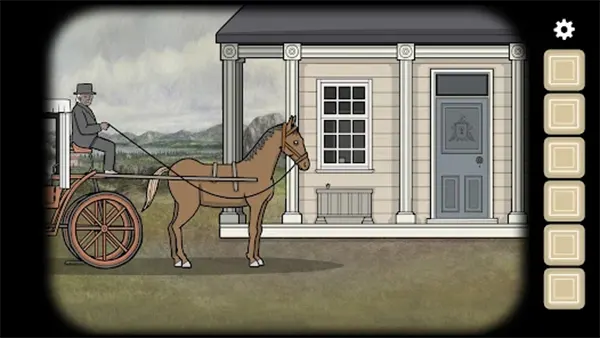
A smaller display places unusual demands on visual storytelling. Fine background details still need to be readable, important objects must stand apart from decoration, and the distinctive character of a location cannot depend entirely on scale. Servant of the Lake responds by retaining the recognisable hand-drawn 2D identity of the series while expanding the environmental artwork. Artist Johan Scherft produced new work for the house, surrounding landscape and Vanderboom characters. His landscape process combined watercolour and pencil with layered painted elements. Rusty Lake then used those layers to create a parallax effect in outdoor scenes, where parts of the background move at different speeds and give the otherwise two-dimensional environment a greater impression of depth.
This technique is particularly suitable for a phone because it creates movement without filling the display with visual effects. The carriage journey in the introductory sequence is one example: layered scenery can suggest distance and travel while retaining the illustrated appearance associated with the series. Similar thinking applies to transitions and outdoor locations around the mansion. The intention is not to replace the original visual identity with three-dimensional graphics. Instead, movement is added to painted scenes where it supports atmosphere. As a result, the screen can remain relatively clean for puzzle solving while still giving the estate more visual life than a completely static collection of backgrounds.
The portraits of Aldous, William and Alexandra also demonstrate how art contributes directly to the narrative. Scherft created painted versions of the three characters, and Rusty Lake has explained that these portraits influenced both the understanding of their personalities and ideas for puzzles. That relationship is important in a game where players are expected to examine visual details closely. A painting can be decoration, a character reference and a potential source of information at the same time. On a smartphone, where the player’s attention is concentrated within a physically smaller frame, this reuse of visual material helps each scene communicate more without requiring extra menus or lengthy explanations.
What the 2026 Mobile Release Says About Rusty Lake’s Design
Audio has also become a larger part of the experience than in many early Rusty Lake releases. Victor Butzelaar composed the soundtrack, while the production includes harp performed by Lavinia Meijer, alto flute by Liset Pennings and vocals by Iris Muller. Driftwood Audio worked on the sound effects with the aim of giving different spaces in the Vanderboom house their own acoustic identity. Furniture and interactive objects received individual sounds, while environmental details include rain, thunder and creaking wooden floors. These elements are useful on a phone because audio can communicate that an action has worked and make a small visual space feel larger. Headphones are not required, but they allow much of this work to be heard more clearly.
Voice acting reinforces the same approach to storytelling. The 2026 release includes Paul Guyet as William Vanderboom, DB Cooper as Alexandra, Bob Rafferty as Aldous, Kara Edwards as the maid and Mike Wijdenbosch as the coachman. Rather than relying only on written dialogue, character performance can establish mood and personality while the player continues interacting with the environment. Rusty Lake also prepared extensive localisation: Apple’s listing includes English and 20 additional languages on iOS. For a story-heavy mobile release, localisation is especially relevant because dialogue, instructions and puzzle information need to remain understandable on a compact screen rather than being treated as secondary material.
The most consequential development change happened behind the scenes. During 2026, Rusty Lake moved the entire game to Unity, a process the studio said took roughly six months and required substantial testing and refinement. The immediate reason was long-term continuity after uncertainty surrounding Adobe’s software ecosystem, while the new engine also makes future console releases easier. For smartphone players, the more important result is that iOS and Android were part of the main release on 13 August rather than receiving a simplified later edition. Rusty Lake combined that technical change with an interface overhaul, a notebook, new artwork, expanded sound design and continued post-release bug fixes. Servant of the Lake therefore represents an adaptation based less on changing the genre and more on removing the small obstacles that can make a narrative puzzle game uncomfortable on a phone. The story remains slow enough to reward observation, the puzzles remain interconnected, and the touchscreen becomes a straightforward way to interact with the strange routines of the Vanderboom household.
Game Bestsellers
-
 Mobile Games and Online Casino: A New Form of Interactive Entertain...
Mobile technology has reshaped modern entertainment habits, allowing users to …
-
 Warframe Mobile — Can a Full Looter-Shooter Experience Work on Smar...
The arrival of Warframe Mobile has raised a practical question …
-
 Call of Duty: Warzone Mobile Performance Analysis Across Modern Dev...
Call of Duty: Warzone Mobile has become one of the …