
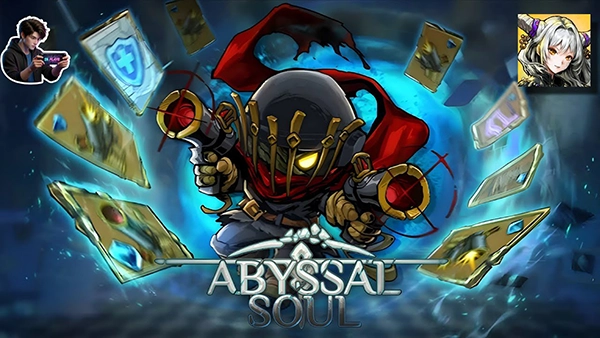
Abyssal Soul: Combat System and Character Progression in the New Mobile RPG
Abyssal Soul is a mobile roguelike card RPG from ChillyRoom, the studio known for Soul Knight and Otherworld Legends. Released for mobile devices in 2026, the game combines turn-based battles, deck building and long-term character development within a dark fantasy setting. Its defining idea is simple enough to understand but changes the usual rhythm of card combat: playing one card can sacrifice several cards positioned after it, so the order of a hand becomes just as important as the individual cards it contains. Each attempt, called a ritual, involves choosing a character, planning a route, collecting cards and other upgrades, and facing increasingly dangerous anomalies. Character growth continues beyond individual runs through permanent progression systems, while the September 2026 Season 2 update expanded the game further with the Dancer class and four new characters. The result is an RPG where tactical decisions matter more than quick reactions, yet the basic rules remain accessible to players who are relatively new to deck-building games.
How the Abyssal Soul Combat System Works
Combat in Abyssal Soul is turn-based and built around what ChillyRoom calls sequential card battles. Many card RPGs rely primarily on mana, action points or another resource that limits how many abilities can be used during a turn. Abyssal Soul approaches the cost of an action differently. Playing a card may consume a number of cards that follow it in the sequence, effectively turning part of the hand itself into a resource. A powerful card can therefore solve an immediate problem while removing several other options that might have been useful later in the same sequence. This makes card position important from the first turn of a fight. Players are not simply choosing the strongest available attack; they are considering what will disappear when that card is activated and whether the immediate benefit is worth losing the cards behind it.
The system becomes easier to manage because enemy actions are visible in advance. Players can inspect the opponent’s upcoming card sequence before deciding how to respond, and there is no real-time pressure forcing an immediate choice. If an enemy is preparing a dangerous action, the player has an opportunity to arrange the current hand around that threat rather than relying on fast reflexes. The same principle applies when an opponent is less threatening and there is room to prepare a stronger sequence for later. Combat therefore develops as a series of short tactical problems: decide which card is most valuable now, identify which cards can safely be sacrificed and consider what the enemy is expected to do next. The rules are unusual, but they are presented through a conventional turn-based structure that gives players enough time to understand their options.
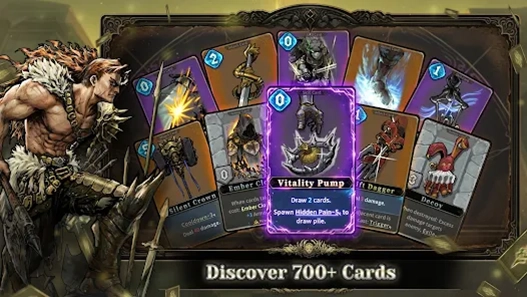
Deck building adds another layer without turning every battle into a complicated calculation. The current game description lists more than 700 cards alongside over 170 Auras, 50 Runes and 85 Amulets, giving individual runs a large pool of possible combinations. These numbers do not mean that a new player needs to memorise hundreds of effects. A run gradually introduces new choices as cards and supporting upgrades are collected, so a build develops over time rather than appearing all at once. Classes also have their own card pools and mechanics, which reduces the number of relevant options during a particular run. This structure helps give each character a recognisable fighting style while retaining the unpredictability expected from a roguelike. Two attempts with the same character can develop differently depending on route choices, rewards and the cards that become available.
Sacrifice, Card Position and Enemy Intent
The sacrifice rule is what gives ordinary card placement unusual importance. Imagine that a valuable attack requires the cards immediately following it to be consumed. Placing less important cards behind that attack can make the exchange worthwhile, while putting another key ability in the sacrifice position could remove an option that would have been essential later in the turn. This creates meaningful decisions even before damage is dealt. A card is not valuable only because of the effect written on it; its position relative to other cards can change how useful the entire sequence becomes. As a result, improving at Abyssal Soul is largely about recognising which parts of the hand can be given up and which need to be preserved. The game rewards planning, but the underlying question remains easy to understand: what do I gain from this play, and what am I giving up to make it?
Enemy intent makes that decision more informed. Because upcoming actions can be checked before committing to a move, players can decide when immediate protection is more useful than aggressive play and when it is safe to prioritise damage or preparation. A difficult encounter may punish a sequence that spends too many useful cards early, while another opponent may give enough room to set up a more ambitious combination. This is also why simply collecting cards with impressive individual effects is not always enough. A successful deck needs cards that work comfortably within its sequence rather than several powerful options that constantly interfere with one another. The system encourages players to judge a card in the context of the complete build, which becomes increasingly important as additional rewards are added during a ritual.
The 14 difficulty tiers provide a long-term way to test that understanding. Lower settings allow players to become familiar with characters and card interactions, while later tiers place greater pressure on efficient decisions and consistent builds. Since combat is not controlled by an action timer, increasing difficulty does not suddenly require faster hands or better reflexes. Instead, the challenge comes from making better use of the information already available. A failed encounter can often reveal a practical weakness: the deck may contain too many competing cards, an important card may have been sacrificed at the wrong moment, or the chosen build may not provide a reliable response to a particular enemy pattern. That makes repeated attempts useful for learning the combat system rather than simply repeating the same battle until favourable random rewards appear.
Classes, Characters and Different Ways to Build a Fighter
Abyssal Soul uses classes to give its large card collection a clearer structure. Earlier versions of the game were built around four principal class groups: Warriors, Musicians, Wuxia fighters and Sorcerers. These were designed around different card pools and combat mechanics rather than functioning as cosmetic variations of the same character. The roster continued to grow after release. Season 2, introduced in September 2026, added Dancer as a new class with its own cards, Amulets and Sanctuary progression. This is an important distinction when looking at older descriptions of the game, because some store information still refers to the earlier four-class, 17-character configuration. The live version has already moved beyond that original structure, and the Dancer update demonstrates that ChillyRoom is treating classes as expandable parts of the RPG rather than a fixed selection established permanently at launch.
Characters provide a second layer of identity inside these classes. ChillyRoom describes individual characters as having their own starting builds, exclusive cards and talent trees, meaning that two characters associated with a broader style do not necessarily approach a run in exactly the same way. Character selection therefore influences both the opening stages of a ritual and the direction in which a deck can naturally develop. The starting cards establish the first workable strategy, while later rewards can strengthen that strategy or move it towards a different combination. This gives players a reason to learn individual characters instead of treating the roster as a collection of visual skins. It also makes progression easier to understand: rather than trying to build every possible combination immediately, a player can first learn how one character’s starting deck and special tools interact with the wider card pool.
The September update illustrates this approach particularly well. Dancer arrived with four characters: Danseuse, Returner, Shadow and Dervish. The update also introduced Dancer-specific cards and Amulets instead of simply adding the characters to an existing class collection. That gives the new group its own mechanical identity and extends the number of possible builds without forcing existing classes to absorb an unrelated set of cards. For someone starting in 2026, this means guides or roster descriptions written around the game’s earlier beta or launch state may no longer represent the complete selection. It is more useful to think of Abyssal Soul as a growing class-based RPG in which a class establishes the broad rules of a build, while an individual character determines its starting point and some of its distinctive possibilities.
Permanent Character Growth Between Rituals
Roguelike progression normally involves losing much of what was collected when a run ends, and Abyssal Soul retains that structure while giving players several ways to carry progress forward. ChillyRoom describes two main development paths: card upgrades and character development. Characters become stronger across repeated rituals rather than existing only in the temporary state created during a single attempt. Their talent systems and individual progression give repeated play a purpose even when a run does not reach its final objective. This separation between temporary and permanent growth is central to the RPG side of the game. Cards, Auras and other rewards collected during a ritual shape the immediate build, while persistent character development gradually changes the foundation from which later attempts begin.
The Memento system creates a more direct connection between consecutive rituals. Instead of losing every useful card when an attempt ends, Memento allows a particularly valuable card to be carried into the next ritual. This does not remove the roguelike reset, because most of the previous build still has to be reconstructed, but it lets one successful part of an earlier strategy survive. Choosing a Memento can therefore influence the next run from its opening stages. A card that worked particularly well with a character’s core mechanics may be more useful to preserve than a powerful card that depended on several temporary upgrades. In practical terms, the feature makes failed attempts feel less isolated: the player can take one useful piece of the previous build and use it as a starting point for another approach.
The Sanctuary provides another visible part of long-term class development. Season 2 added a level 25 Dancer Statue to the Sanctuary while also raising the level limit for existing classes, confirming that ChillyRoom continues to extend permanent progression alongside new seasonal content. The developers do not publicly document every progression formula in the store description, so it is better to treat specific upgrade values as information that can change between versions rather than as permanent rules. What remains consistent is the broader structure: individual rituals supply temporary build decisions, while characters and classes have development systems that remain relevant across multiple attempts. This balance prevents progression from depending entirely on a lucky run and gives players clear reasons to continue improving a preferred character after becoming comfortable with the basic combat rules.
How to Build a Strong Character Without Making the Game Complicated
A good starting approach in Abyssal Soul is to build around one clear idea rather than collecting every interesting card that appears. The game includes recommended builds intended to help newer players understand useful combinations, and these can serve as a practical reference before experimenting with less obvious setups. The sacrifice mechanic makes this especially important because every extra card does more than affect what can be drawn; it can also become part of the cost of another action. When considering a reward, it is worth asking whether the new card supports what the character already does well. If it introduces an entirely separate plan that requires several additional rewards to become useful, leaving it behind may produce a more predictable deck. A smaller set of cards that cooperate with each other is usually easier to sequence than a collection of individually attractive effects with no shared purpose.
Auras, Runes and Amulets should be treated as supporting pieces of that plan rather than separate objectives. With more than 170 Auras, 50 Runes and 85 Amulets listed in the current game, it is unrealistic to approach every ritual with one fixed combination in mind. Roguelike rewards are variable by design, so adaptation is part of character building. If a run repeatedly provides upgrades that reinforce an existing strength, following that direction can be more practical than waiting for a specific ideal item. The same applies to card upgrades. Strengthening an ability that already fits comfortably into the sequence can improve the whole deck, while upgrading an awkward card does not automatically solve the problems created by its position or cost. Character development is therefore less about chasing one universal build and more about recognising which available rewards complement the run that is actually taking shape.
Route selection also affects how quickly that build develops. Rituals involve choosing paths and collecting cards and other upgrades before facing later encounters, so the journey between fights is part of the progression system rather than simple decoration. Players who are still learning a character can benefit from choosing routes that allow the build to become stable before taking unnecessary risks, while stronger permanent progression can make more demanding paths manageable later. The 14 difficulty tiers support the same gradual approach. Moving to a harder tier is most useful once the current level can be handled consistently, because higher difficulty exposes weaknesses in a build that may have gone unnoticed earlier. Progress in Abyssal Soul is therefore not measured only by character statistics; it also comes from becoming better at recognising useful rewards, planning card order and understanding what a particular character needs during a run.
Why Abyssal Soul Feels Different from a Typical Mobile RPG
The clearest difference is that combat is neither traditional mobile action nor a conventional turn-based system where the strongest available skill is usually the obvious choice. Sequential sacrifice gives every card a second role: it can be an action the player wants to use or a resource that may need to disappear so another action can happen. This creates tension without requiring complicated controls. Enemy sequences are visible, turns have no strict time limit and the essential interaction remains choosing and arranging cards. The difficulty comes from consequences rather than speed. A seemingly harmless decision early in a sequence can remove a valuable option several moves later, while careful positioning can turn ordinary cards into useful material for a stronger action. That gives battles a distinct rhythm even for players who have already spent considerable time with other roguelike deck builders.
The character system also separates Abyssal Soul from mobile RPGs where progression mainly means increasing a combat-power number. Permanent development matters, but a stronger character still needs a coherent deck during each ritual. At the same time, the roguelike reset is softened by character growth, card development and Memento inheritance, so losing a run does not mean that every form of progress disappears. This combination allows the game to maintain uncertainty without making repeated attempts feel completely disconnected. The player gradually develops a stronger permanent foundation while still having to work with different card rewards and route choices in each ritual. It is a useful compromise between an RPG, where long-term advancement is expected, and a roguelike deck builder, where adaptation to changing rewards is a major part of the challenge.
As of September 2026, Abyssal Soul is available on Android and iOS and continues to receive post-release content. The arrival of Season 2 and the Dancer class shortly after the initial mobile release shows that its combat and progression systems are already being expanded rather than remaining limited to the launch roster. Its strongest idea remains the connection between card sequence and sacrifice: characters, talent trees, Amulets, Runes and permanent upgrades all matter, but they ultimately support decisions made during turn-based encounters. Players do not need extensive knowledge of complex card-game terminology to understand the central rule. Preserve the cards that matter, sacrifice the ones that can be spared, read what the enemy is preparing and build around the strengths of the chosen character. That simple framework is what holds the wider progression system together as the roster and seasonal content continue to grow.
Game Bestsellers
-
 Mobile Games and Online Casino: A New Form of Interactive Entertain...
Mobile technology has reshaped modern entertainment habits, allowing users to …
-
 Warframe Mobile — Can a Full Looter-Shooter Experience Work on Smar...
The arrival of Warframe Mobile has raised a practical question …
-
 Call of Duty: Warzone Mobile Performance Analysis Across Modern Dev...
Call of Duty: Warzone Mobile has become one of the …